

Table of Contents
- Why Goddess Braids Frizz (And How to Stop It Before It Starts)
- How to Keep Human Braiding Hair from Frizzing: Step-by-Step Routine
- How to Prevent Goddess Braids from Tangling at the Roots and Ends
- Frizzy Boho Braids? How to Fix Them Without Starting Over
- Mousse for Braids: How Much, Where, and How Often
- Nighttime Protection: Satin Bonnets, Pillowcases, and Sleep Position
- Washing Braids Gently Without Causing Frizz
- When to Refresh, Visit a Stylist, or Take the Style Down
- Frequently Asked Questions
Last Updated: October 5, 2026
Why Goddess Braids Frizz (And How to Stop It Before It Starts)
Preventing frizz in goddess braids comes down to three things: dry hair, friction, and product buildup. Stop all three and your style stays neat for weeks.
Goddess braids and boho braids look soft because loose curls are left out along the braid. Those curls are also the first place frizz shows up, rubbing against pillows, collars, and hands all day.
Preventing frizz in goddess braids is less about buying more products and more about doing four things well:
- Prepping hair with real moisture before installation
- Keeping hands off the style between refreshes
- Protecting braids at night with satin
Below: each step, how to fix existing frizz, and when to take the style down.
How to Keep Human Braiding Hair from Frizzing: Step-by-Step Routine
Keeping human braiding hair from frizzing starts before the braider picks up a single strand. A good routine has two phases: prep and install.
Step 1: Prep Your Natural Hair Before Installation
Wash and deep condition your natural hair 24 to 48 hours before your appointment. Hair that goes into braids dry pulls moisture from the braiding hair and frizzes at the roots.
Follow these prep steps:
- Clarify with a gentle shampoo to remove buildup.
- Apply a deep conditioner and let it sit for 20 to 30 minutes.
- Rinse, then blot with a microfiber towel.
- Apply a light leave-in to damp hair.
- Air dry or blow dry on low heat.
- Do not add heavy grease or thick butters before installing.
Step 2: Install with Frizz Prevention in Mind
The install decides how the next four to six weeks go. Ask your braider to keep tension even and avoid over-gripping the loose curls.
A few habits that protect the style from day one:
- Use 100% human braiding hair, not synthetic blends
- Keep the leave-out sections small and light
- Avoid daily oiling at the roots, which loosens the braid
Human braiding hair matters here. Our Deep Wave and Burmese Curly bundles are soft, tangle-free, and lightweight, so the loose curls move without matting. One customer put it simply: "I love the human braid hair! It's soft and most of all it doesn't tangle!"


How to Prevent Goddess Braids from Tangling at the Roots and Ends
Tangling at the roots and ends is a friction problem, with three main sources: hands, fabric, and product.
Roots tangle when new growth lifts the braid and the base loosens; ends tangle when loose curls rub together or catch on rough fabric. Both worsen when you touch the style too often.
Try this routine:
- Separate curls gently with your fingertips, never a comb
- Mist the ends with a light refresh spray, then smooth with your palm
- Avoid daily oiling at the scalp
Frizzy Boho Braids? How to Fix Them Without Starting Over
Frizzy boho braids can usually be fixed in 15 minutes without taking the style down, but the fix depends on where the frizz lives. Roots, mid-braid, and loose curls each fail for different reasons, and treating them the same is why most at-home fixes only last a day.
Diagnose first, then treat:
- Fuzzy roots, new growth has lifted the braid base, or product buildup has attracted lint and dust. This is a structural issue, not a moisture issue.
- Frayed mid-braid length, the braid itself is rubbing against collars, seatbelts, or rough fabric, causing the outer strands to lift.
- Frizzy loose curls, the leave-out curls have lost moisture and definition, usually from friction or dry air.
Fixing Fuzzy Roots Without Loosening the Braid
Do not pick at the roots with your nails or a rat-tail comb, that lifts the base and pulls natural hair out. Instead:
- Dip a clean mascara wand or soft toothbrush in a tiny amount of lightweight gel or edge control.
- Sweep it along the part lines and the first inch of each braid, following the direction the braider laid the hair.
- Press the roots flat with your palm for 10 seconds, then leave them alone.
If the fuzz is widespread, the braids have grown out past home fixing. A stylist can redo the first two or three perimeter rows without removing the whole style, far cheaper than a full reinstall.
Smoothing Frayed Braid Lengths
Mid-braid fray usually comes from friction, not dryness. Remove the cause before adding product:
- Check jacket collars, scarf materials, and seatbelt straps, wool, heavy cotton, and rough knits snag the braid surface.
- Switch to a silk or satin scarf around your neck with high-collared coats.
- Mist the frayed section lightly with water, then smooth downward with a small amount of lightweight mousse on your fingertips.
Do not wrap the braid in tape, rubber bands, or hair ties to hide the fray. These create tension points that thin the braid and damage the natural hair underneath.
Restoring Frizzy Loose Curls
This is the fix most people get right, but timing matters:
- Fill a spray bottle with water and a few drops of lightweight leave-in conditioner. Shake well.
- Mist only the frizzy curls, not the whole head, saturating the braids causes buildup at the base.
- Smooth each curl between your palms from mid-shaft to tip.
- Wrap individual curls around your finger in the direction of the natural curl pattern, hold, and release.
- Air dry. Never use a blow dryer, flat iron, or curling iron on the leave-out curls, heat damage on human braiding hair is permanent.
When Home Fixes Stop Working
If you are re-fixing the same sections every two or three days, the style is telling you something. Repeated misting and smoothing causes product buildup, which attracts lint and worsens the next frizz cycle. Book a stylist for a perimeter touch-up or plan your takedown, pushing a style past the point where it holds its shape damages your natural hair more than removing it early.
Mousse for Braids: How Much, Where, and How Often
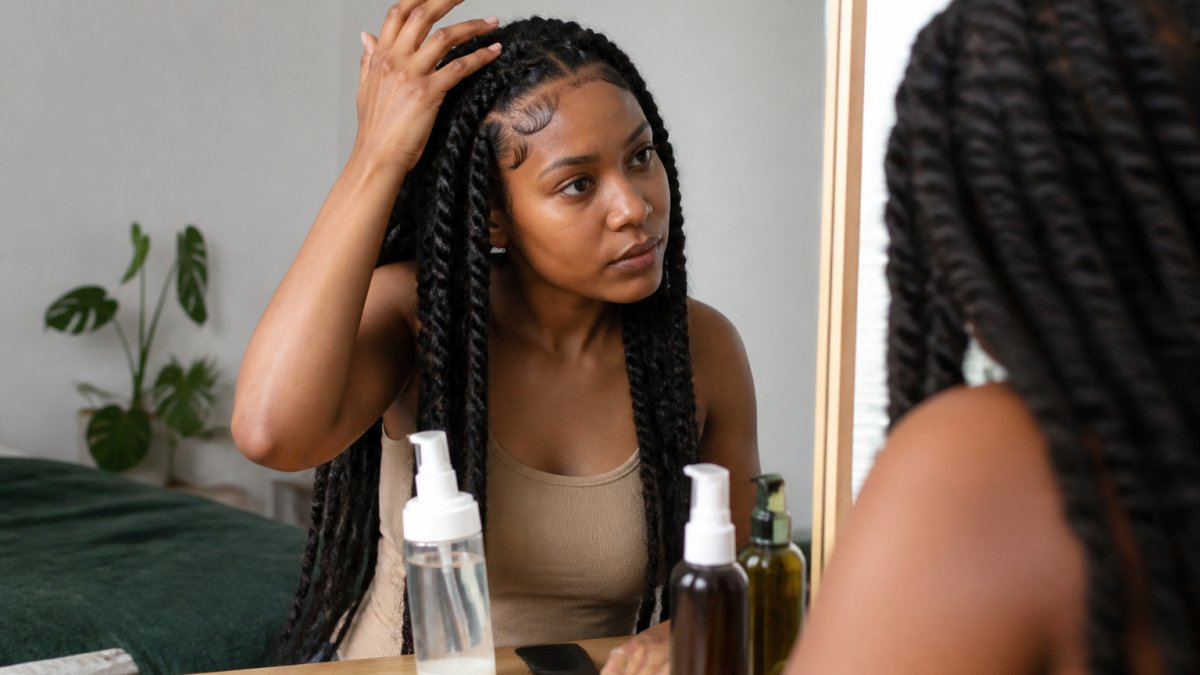
Mousse for braids works best in small amounts, applied to the loose curls and ends only, once or twice a week. More than that causes product buildup, which makes frizz worse.
Match the Product to the Hair Type
Not all braiding hair behaves the same way with product:
- 100% human braiding hair, absorbs lightweight mousse and leave-in well, holds curl definition, and tolerates a refresh spray once or twice a week. It can also be re-wet and re-curled with water alone, the gentlest option.
- Synthetic braiding hair, does not absorb product. Mousse sits on the surface, attracts dust, and can make curls look greasy or stiff. Use the smallest possible amount, or skip mousse and rely on water and finger-shaping.
- Blended hair (human + synthetic), treat it like synthetic. The synthetic fibers dominate how the hair responds, even if the label says "human blend."
If you are not sure what your braids are made of, test on one curl at the nape before applying anything to the visible leave-out.
Amounts, Locations, and Frequency
| Product | Amount | Where to Apply | How Often |
|---|---|---|---|
| Lightweight mousse | A golf-ball size for the whole head | Loose curls and ends only | 1-2 times a week |
| Refresh spray | A few light mists | Frizzy sections only | As needed, up to daily |
| Leave-in conditioner | A coin-size drop | Ends | After each wash |
| Lightweight gel or edge control | A pea-size amount | Roots and part lines | Only when roots are fuzzy |
Apply mousse with your fingertips, not your palms, working from the middle of the curl to the end. Scrunch gently, then leave it alone, touching curls while they dry breaks the cast and creates the frizz you are trying to prevent.
Skip heavy oils, petroleum-based products, and thick butters. They sit on top of the hair, attract dust, weigh curls flat, and build up at the braid base, loosening the install over time.
Humidity, Exercise, and Swimming
Environmental triggers cause more frizz than most people realize and need different handling than everyday maintenance:
- Humidity, human hair curls absorb moisture from the air and expand, breaking up the curl pattern. A light layer of mousse or humidity-resistant finishing spray on the leave-out curls before you go outside helps. Synthetic hair is less affected but can still frizz from static.
- Exercise, sweat at the scalp and hairline is the main culprit. Rinse the scalp with cool water after a workout, blot with a microfiber towel, and air dry. Do not let sweat sit at the roots; it attracts lint and breaks down the braid base.
- Swimming, chlorine and salt water strip moisture from human braiding hair and roughen the cuticle. Wet the braids with clean water before entering the pool so they absorb less chlorine, and rinse thoroughly with cool water immediately after. If you swim regularly, plan on a shorter wear time.
Signs You Are Using Too Much Product
Product buildup is the most common cause of "mystery frizz" in goddess braids. Watch for:
- Curls feel stiff or crunchy instead of soft
- White flakes appear at the roots or on your bonnet
- The braids feel heavy or greasy near the scalp
If you see any of these, stop applying product for a week. Rinse the scalp with diluted shampoo, air dry, and reset with water and finger-shaping only. Less product, applied less often, keeps goddess braids fresher longer.
Nighttime Protection: Satin Bonnets, Pillowcases, and Sleep Position
Satin is the single most effective frizz tool you own. Cotton pillowcases pull moisture from your hair all night. Satin does not.
Your nighttime routine should take under a minute:
- Tie braids loosely into a low pineapple or ponytail
- Cover with a satin bonnet or wrap
- Use a satin pillowcase as backup
Satin bonnets and pillowcases work together: the bonnet protects the braids, the pillowcase protects anything that slips out overnight.
If you travel often, pack both. A bonnet takes up almost no space, and it is the difference between a style that lasts four weeks and one that looks tired at two.
Washing Braids Gently Without Causing Frizz
Washing braids is safe when you focus on the scalp and keep the loose curls out of the way. Wash every two to three weeks, not weekly.
Use diluted shampoo in gentle circular motions with your fingertips, do not scrub the braids themselves. Rinse with cool water, since hot water opens the cuticle and roughs up the hair.
After washing:
- Blot with a microfiber towel, never rub
- Let braids air dry
- Mist the loose curls with leave-in
When to Refresh, Visit a Stylist, or Take the Style Down
Refresh at home when frizz is mild, book a stylist when roots have grown out or braids have loosened, and take the style down when new growth is hard to manage or the scalp is irritated.
Use this guide:
- Refresh at home: frizzy ends, flat curls, dull shine
- See a stylist: fuzzy roots across the whole head, loose braids, visible gaps
- Take it down: scalp pain, itching that will not stop, matting at the base, or 6-8 weeks have passed
Never push a protective style past eight weeks. Goddess braids exist to protect your natural hair, and leaving them in too long does the opposite.
When you are ready for your next install, choose hair that holds its curl and stays soft. Our Italian Curl and Body Wave bundles are 100% human hair, reusable, and made to keep their texture through multiple installations, the difference between a style that looks fresh at week five and one that frizzes by week two.

Frequently Asked Questions
Does mousse help prevent frizz in goddess braids?
Yes, lightweight mousse helps prevent frizz by smoothing the hair cuticle and adding light hold without weighing curls down. Apply a small amount to your fingertips and smooth it over the braid roots and loose pieces. Avoid heavy gels or thick butters, which attract dust and cause product buildup. For best results, use mousse every 2-3 days or when frizz starts to appear.
How often should I apply mousse to goddess braids?
Apply mousse every 2-3 days, or whenever you notice fuzzy roots or loose curls losing definition. Over-application causes product buildup that can lead to tangling and matting. Start with a dime-sized amount per section, focusing on the roots and any loose curls. If you exercise or live in a humid climate, you may need to refresh more frequently, but always let braids dry fully before sleeping.
How can I keep the curly pieces in goddess braids from tangling?
Separate curls gently with your fingers daily, working from the ends upward. Never use a brush or comb on loose curls, as this causes frizz and breakage. Lightly mist with a refresh spray or water-based leave-in conditioner, then scrunch the curls to reshape them. At night, protect the curls with a satin bonnet or pillowcase to reduce friction. If tangles form, use your fingertips to gently pull them apart rather than pulling through.
Can I refresh frizzy goddess braids without reinstalling them?
Yes, you can refresh frizzy goddess braids without a full reinstall. Start by misting the braids with a lightweight refresh spray or water-based leave-in conditioner. Use your fingertips to smooth fuzzy roots and redefine loose curls. Apply a small amount of mousse to the roots and scrunch the ends. For stubborn frizz, wrap the braids with a satin scarf for 20-30 minutes to set the style. If frizz is severe or the braids are matted, visit a stylist for a professional refresh or consider taking the style down.
Frizz in goddess braids is a maintenance problem, not a hair problem. Prep with moisture, protect with satin, use light products, and keep your hands off the style. Fula Beauty Collection makes that easier with soft, tangle-free human hair bundles that hold their curls and stay lightweight. Shop the look and start your next install with hair built to last.