

Table of Contents
- What Makes Human Hair Durable for Sew-Ins
- Hair Weft Quality: What to Check Before You Buy
- Remy Human Hair Sew-In Bundles vs. Virgin and Raw
- Choosing Bundle Quantity, Length, and Texture
- How to Care for Sew-In Bundles
- How Long Can You Reuse Human Hair Bundles for Sew-Ins?
- Conclusion
- Frequently Asked Questions
Last Updated: October 14, 2026
What Makes Human Hair Durable for Sew-Ins
Durable human hair for sew-ins keeps its cuticle intact, holds texture through washing and heat styling, and resists tangling and shedding across multiple installs.
At Fula Beauty Collection, we work with stylists who install wefted bundles regularly, and the pattern is consistent: the hair that lasts was never chemically stripped.
Cuticle Alignment and Unprocessed Hair
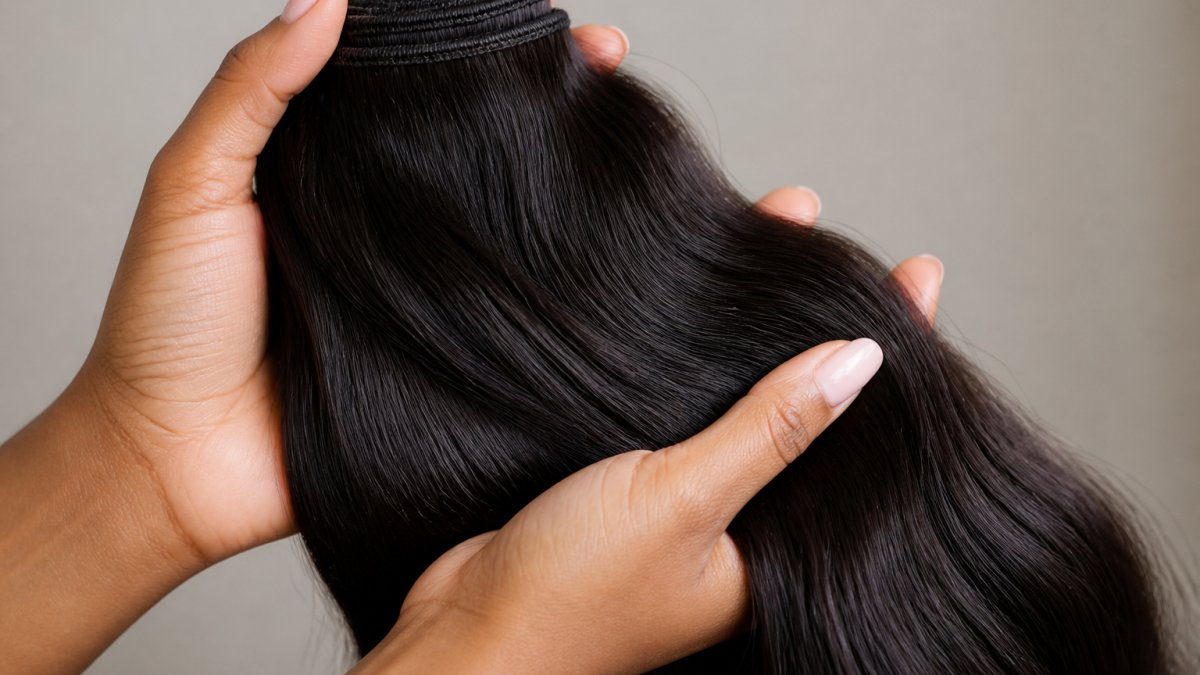
Unprocessed hair still has its cuticle layer intact, not acid-washed, silicone-coated, or chemically stripped to fake softness.
A quick test: run your fingers from weft to tip, then tip to weft.
Hair Weft Quality: What to Check Before You Buy
Weft quality is the most underrated factor in how long a sew-in lasts. The weft takes all the tension from braided sections and stitching, and a weak one sheds from the seam no matter how good the hair is.
Here's what to inspect before you buy:
- Seam density: Hold the weft up to light. You should see tight, even stitching with no gaps.
- Reinforcement: A double-stitched or reinforced seam holds up to cutting and sewing better than a single row.
- Shedding test: Grip the weft near the seam and run your thumb firmly along it. A few stray hairs are normal. A clump is not.
Machine Weft vs. Hand-Tied Construction
Machine wefts are sewn in a tight, continuous row: denser, thinner at the seam, better for flat seamless finishes, and they handle cutting into narrower strips well.
Hand-tied wefts are knotted by hand onto a thinner base.
For most sew-ins, a well-made machine weft is the more forgiving choice; hand-tied suits sensitive scalps willing to handle the extra care.
Remy Human Hair Sew-In Bundles vs. Virgin and Raw
| Type | Cuticle | Processing | Texture Consistency | Wear Pattern |
|---|---|---|---|---|
| Remy | Aligned | Minimal | Consistent bundle to bundle | Holds style well, resists tangling |
| Virgin | Aligned, intact | None | Consistent | Soft, long-lasting, colour-friendly |
| Raw | Aligned, intact | None | Varies by donor | Very natural, needs matching |
The overlap is real: good virgin hair is usually also Remy, and raw hair is virgin by definition.
The common advice that raw hair is always the better buy isn't quite right: it demands more matching work and careful maintenance.
Remy human hair sew-in bundles are what most professional installs are built on, and for good reason: the cuticles are aligned, the texture is consistent, and the hair takes heat and colour without drama.
Choosing Bundle Quantity, Length, and Texture
Bundle quantity, length, and texture determine whether your sew-in looks full or flat, and they're the decisions most buyers rush.
For a partial sew-in with a leave-out, two bundles usually cover it, depending on how much of your natural hair you're blending.
Length is a volume decision as much as a style one: going from 18 to 26 inches roughly doubles the surface area the same weight must cover, so longer lengths need more bundles to keep ends full.
Texture should match your natural hair or the finish you want:
- Body wave and loose wave for movement and a soft, everyday look
- Kinky curly for maximum volume and a blend with Type 4 textures
- Kinky straight for a natural blow-dried or pressed look
How to Care for Sew-In Bundles
Most care guides treat a sew-in like loose hair. It isn't. A sew-in is two systems: the exposed bundle hair and your own hair braided underneath. They have different needs, and the routine that keeps one healthy can damage the other. Getting six to twelve months of reuse depends on managing both.

The two-system rule
The exposed bundle hair has no scalp feeding it oil, once cut from the donor, it only gets moisture from what you apply. Your natural hair underneath still produces sebum and needs cleansing, but it's trapped under a braid foundation and weft row. The same wash schedule can't serve both.
A workable split:
- Bundle hair: moisture-focused, low-manipulation, heat-minimal.
- Natural hair underneath: scalp-focused, cleansing-access, tension-aware.
Weekly scalp cleansing without wrecking the install
You don't need to take the install down to clean your scalp. What you need is access and dilution.
- Dilute sulphate-free shampoo one part shampoo to four parts water in an applicator bottle. Full-strength shampoo on braids is hard to rinse and leaves residue that attracts lint and causes matting.
- Apply the diluted mix directly to the scalp in rows, working along the braid foundation with the nozzle, not the length.
- Massage with fingertips, not nails, in small circles between braid rows to shed dead skin and product buildup.
- Rinse thoroughly with cool water, tilting the head so water runs down the length rather than sitting at the roots.
- Follow with a leave-in or scalp tonic on the scalp only, then a light leave-in on bundle mid-lengths and ends.
A once-weekly diluted wash suits dry or flaky scalps; twice weekly is fine if you're active or in humidity, as long as you don't scrub the braid foundation.
Conditioning: mid-lengths and ends only
Conditioner at the roots is the most common cause of a sew-in loosening early: it sits on the braid foundation, softens the pattern, and gives the weft row less to grip. Keep it from the mid-shaft down.
- Rinse-out conditioner: after every wash, mid-lengths to ends, two to three minutes, cool rinse.
- Deep conditioner: every two to three weeks, 20 to 30 minutes under a plastic cap. Focus on the ends, which are the oldest part of the bundle and the first to dry out.
- Leave-in: every few days on the ends, especially in dry or cold climates.
Detangling without pulling the weft
Never detangle top-down, pulling from the seam puts tension on the stitching. Work in small sections from the ends upward with a wide-tooth comb or loop brush.
- Dry detangle first with fingers to remove shed hairs that haven't fallen out yet. Shed hairs trapped in the bundle are what cause matting at the base.
- Then comb from ends to mid-lengths, then mid-lengths to weft.
- Never comb wet unless the hair is loaded with conditioner. Wet hair stretches and snaps, and the bundle hair has no scalp oils to protect it.
Heat: the real durability killer
Heat is where most bundle lifespan is lost. Repeated high-heat flat-ironing breaks down the cuticle's hydrogen bonds, and once compromised, the hair roughens and tangles with itself.
- Keep tools at or below 350°F (175°C) for textured hair, and lower for fine or coloured bundles.
- Always use a heat protectant, a spray or serum, not oil alone. Oil conducts heat; it doesn't buffer it.
- One pass per section. Going over the same section repeatedly is what causes heat damage, not the temperature alone.
Night routine and storage between wears
Friction is the quiet cause of thinning ends. Cotton pillowcases grab the cuticle and rough it up over weeks.
- Braid or twist the hair loosely into two to four sections before bed.
- Wrap in a satin scarf or sleep on a satin pillowcase. Satin, not silk, if you want the most slip for the least cost.
- Loosen the braids in the morning with fingers, not a comb.
Scalp and natural-hair care during the install
This is the part most product-led guides skip, and it decides whether you can reuse the bundle.
- Watch braid tension. If the braid foundation is too tight, you'll get bumps, tenderness, and eventually traction damage at the hairline. A stylist who braids tightly "so it lasts" is trading your edges for two extra weeks of install.
- Don't leave a sew-in in longer than 8 to 10 weeks. After that, the natural hair underneath has shed and matted around the braid foundation, and taking it down becomes a detangling job that costs you more hair than the install saved.
- Give your scalp a break between installs. A week or two of loose or low-tension styling lets the follicles recover before the next braid-down.
A quick weekly schedule
| Day | Action |
|---|---|
| Wash day | Diluted scalp cleanse, mid-length conditioner, deep condition every 2-3 weeks |
| Mid-week | Water-based mist on ends, light leave-in, finger-detangle |
| Nightly | Loose braids, satin wrap |
| Every 2-3 weeks | Full detangle, check weft seam for loose stitches |
Hair that gets this routine holds its texture and fullness far longer than hair that's washed infrequently and heat-styled daily. The bundle is only half the equation, the other half is what happens to the scalp underneath it.
How Long Can You Reuse Human Hair Bundles for Sew-Ins?
Most guides answer this with a single number, which is almost always wrong for your situation. Reuse life depends on three independent variables: hair grade, install frequency, and care between installs. Here's how to estimate your own.
Bundle lifespan vs. time between installs
These are two different clocks, and conflating them is why buyers feel cheated.
- Bundle lifespan is the total months the hair is usable across all installs, including rest periods.
- Install duration is how long it stays in your head in one go, typically 6 to 10 weeks.
- Rest period is the time between installs when the bundle is washed, conditioned, and stored.
A 12-month bundle installed 8 weeks at a time with 2 weeks' rest gives roughly four installs a year; a 6-month bundle on the same schedule gives two. Same care, different grade, different outcome.
Realistic lifespan by hair grade
These are working ranges, not guarantees, assuming sulphate-free washing, heat below 350°F, satin storage, and no chemical processing.
| Grade | Typical reuse count | Total lifespan | What limits it |
|---|---|---|---|
| Remy (cuticle-aligned, lightly processed) | 2-3 installs | 6-12 months | Cuticle wear at the ends; weft seam loosening |
| Virgin (unprocessed, cuticle intact) | 3-4 installs | 9-18 months | Ends thinning from heat and friction |
| Raw (single-donor, unprocessed) | 3-5 installs | 12-24 months | Texture matching as bundles age unevenly |
| Non-Remy or coated "soft" hair | 1-2 installs | 3-6 months | Cuticle stripped; tangling starts within weeks |
A few things to read carefully in that table:
- The ranges overlap. A well-cared-for Remy bundle can outlast a neglected virgin bundle. Grade sets the ceiling; care decides how close you get.
- Raw hair's advantage is conditional. Single-donor bundles last longer because the cuticle is fully intact and the texture uniform, but raw bundles vary in density, mix donors and the thinner one fails first.
- Non-Remy hair is the trap. Sold as "soft" or "silky" because the cuticle is stripped and coated, it feels great on day one and tangles by week three. No care routine fixes a missing cuticle.
How install frequency changes the math
Every install is a stress event: the hair gets braided, sewn, cut, heat-styled, washed, and taken down, and each cycle removes cuticle and loosens the weft.
- Back-to-back installs (no rest): expect the low end, the bundle never fully recovers moisture.
- Two to four weeks' rest: expect the middle to high end, the sweet spot for most people.
- Seasonal wear (two installs a year): a good virgin or raw bundle can last two to three years, since it spends most of its life stored and conditioned.
What actually shortens reuse life
Two things kill bundles faster than anything else:
- Heat damage from repeated high-heat flat-ironing. Once the cuticle's bonds break, the hair roughens and catches on itself, it's irreversible.
- Product buildup from heavy gels, oils, and edge controls not washed out. Buildup attracts lint, lint mats the base, and base matting makes a bundle feel "done" even when the ends are fine.
Secondary factors: chlorine and salt water without a pre-soak, sleeping on cotton, and top-down detangling.
The take-down and reset routine
When you take a sew-in down, the bundle needs a full reset before it goes back in. Skipping this is how a bundle that should last three installs lasts one.
- Detangle fully while dry, before any water touches it, trapped shed hairs mat the moment they get wet.
- Wash gently in a basin with sulphate-free shampoo, working downward from weft to tip. Don't scrunch or pile.
- Deep condition 20 to 30 minutes. A protein treatment every third or fourth wash helps if the hair feels mushy or stretchy.
- Rinse cool to close the cuticle, then blot with a microfibre towel.
- Air-dry on a hanger or flat on a towel. Never dry in a tight bun, the crimp becomes permanent.
- Store in a satin bag, loosely coiled, away from sunlight and humidity. A breathable bag beats sealed plastic, which traps moisture and can mildew.
A quick test before you reinstall
Before committing a bundle to another install, check three things:
- Seam integrity: hold the weft to light. Gaps or loose stitches mean resew or retire it.
- End density: run your fingers from mid-shaft to tip. Noticeably thinner ends mean one install left at most.
- Wet stretch test: wet a small section and pull gently. Hair that stretches and doesn't spring back has lost protein structure and will break next install.
This is where fibre quality shows. Our clients regularly tell us the same thing: "Absolutely love the quality of this hair. I've had my style in for 2 months now, and the curls look even better and fuller than the initial install." Another put it simply: "It's soft and most of all it doesn't tangle." Hair with an intact cuticle and a well-sewn weft can be taken down, washed, and installed again, and again, if you reset it properly between wears.
Conclusion
The challenge with sew-in hair isn't finding something that looks good on install day, it's finding hair that still looks good three months later. That comes down to cuticle-aligned, unprocessed hair and a weft that survives real install tension.
At Fula Beauty Collection, every wefted bundle is 100% human hair, double drawn for uniform fullness, and built to be washed, restyled, and reused. Our bundles come in kinky curly, natural wave, loose wave, kinky straight, and straight, all in 18 to 26 inch lengths, with free worldwide shipping.

Shop the look and start your next sew-in with bundles built to last more than one install.
Frequently Asked Questions
How do I know if human hair bundles are durable?
Check three things: cuticle alignment, weft construction, and whether the hair is unprocessed. Cuticle-aligned hair has all strands running the same direction, which prevents tangling. A tightly stitched weft resists shedding during installation. Look for bundles described as 100% human hair with double drawn ends for uniform thickness. Fula Beauty Collection's wefted bundles use double drawn construction, which means consistent fullness from root to tip rather than thin, wispy ends.
How long can you reuse human hair bundles for sew-ins?
With proper care, quality human hair bundles can typically be reused for two to three installations, depending on how well they are maintained between wears. The key is detangling before storage, washing with sulfate-free products, and keeping bundles in a silk or satin bag away from moisture and sunlight.
What is the difference between Remy, virgin, and raw hair for sew-ins?
Remy hair has cuticles aligned in one direction, reducing tangling. Virgin hair is unprocessed and never chemically treated, so it keeps its natural texture. Raw hair is the most unprocessed option, collected from a single donor without steaming or chemical alteration. Virgin and raw options cost more but can last longer with careful maintenance.
How do you keep human hair sew-in bundles from tangling and shedding?
Detangle gently with a wide-tooth comb starting from the ends and working upward. Wash every two to three weeks using sulfate-free shampoo and a moisturizing conditioner. Avoid heavy products that build up near the weft, where shedding often starts. Before bed, wrap or braid the hair loosely and cover it with a satin scarf. If you heat style, use a protectant spray and keep tools below 350°F (175°C) to prevent cuticle damage that leads to tangling.
How many bundles do I need for a full sew-in?
For a partial sew-in with leave-out, two to three bundles usually give enough coverage. A full sew-in typically needs three to four bundles, depending on your natural hair density and the length you choose. Longer lengths (22 to 26 inches) may require an extra bundle because the hair is thinner at the ends. Fula Beauty Collection's Kinky Straight Wefted Bundle comes in lengths from 18 to 26 inches, each bundle weighing 100g, so you can calculate volume based on your install type.
Can I color or heat style durable human hair bundles?
Yes. Fula Beauty Collection's wefted bundles are 100% human hair and can be bleached, dyed, flat ironed, and curled. Use a protectant spray before heat styling and keep tools below 350°F (175°C). When coloring, go no more than two shades lighter than the original tone in one session to avoid over-processing. Deep condition after any chemical service to restore moisture and keep the cuticles smooth.